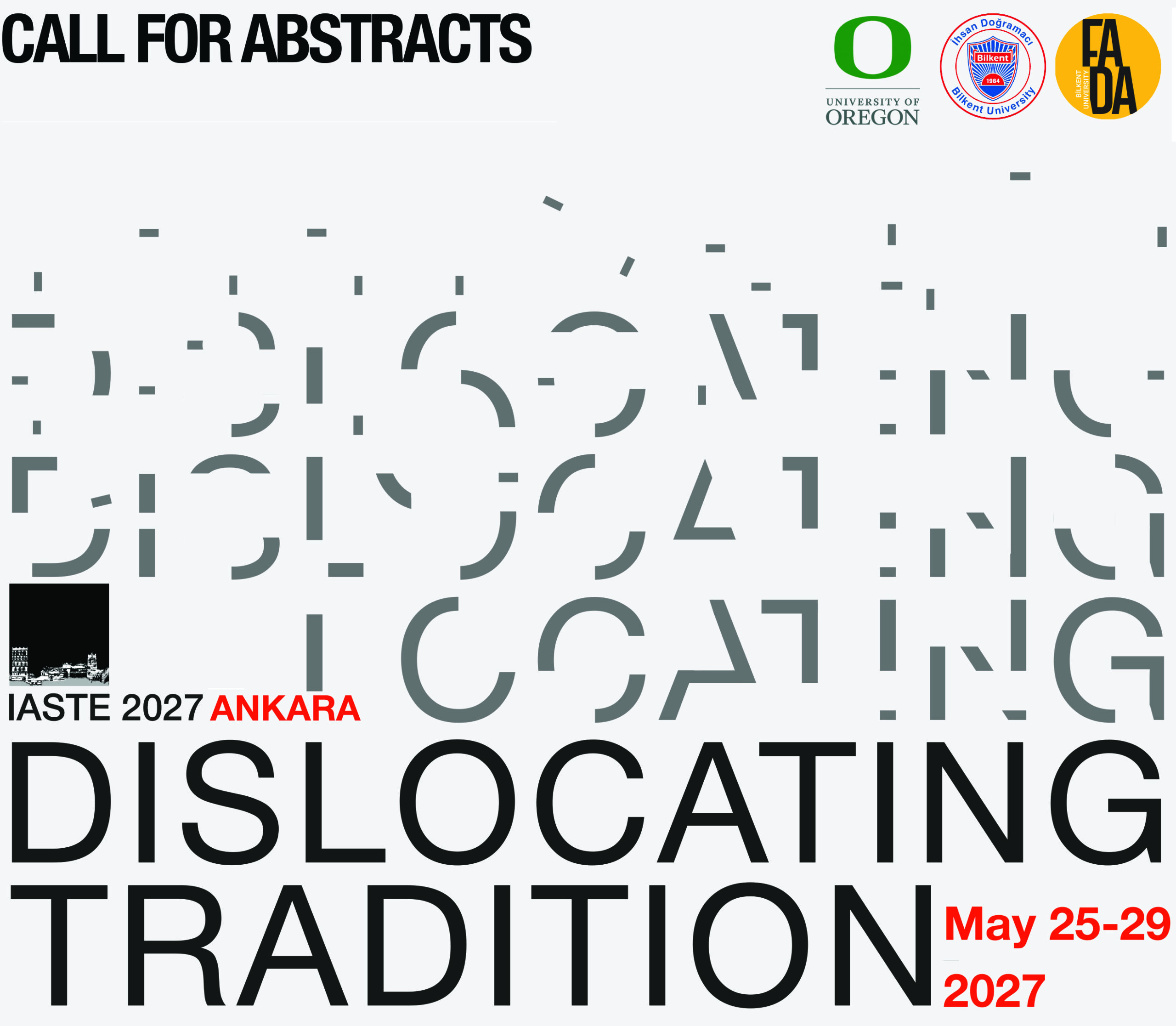
IASTE 2027 ANKARA
CALL FOR ABSTRACTS
TRACKS | DEADLINES | REQUIREMENTS | COMMITTEES | VENUE | HOTEL
CONFERENCE THEME
Tradition has long been conceived as essentially linked to location. Accordingly, tradition as cultural production “takes place” at a certain location, and thus, location generates belonging. Past IASTE conferences and contributions in IASTE’s journal, Traditional Dwellings and Settlements Review (TDSR), have critiqued such a static spatial ontology and defined tradition as a dynamic process of becoming. While many scholars characterized the late twentieth century as an “age of migration”—a term that carried a rather positive connotation emphasizing the increased mobility of labor under conditions of globalization—the current epoch. Today, we see a growing number of forced migrants, refugees, and dislocated populations, whose number is the highest since the end of WWII. In this respect, today, it is more accurate to say that we are in an age of dislocations.
In this era, tradition cannot remain static; it is subject to further dynamism through dislocation. Dislocated individuals rebuild communities by making places in new destinations in a process often guided by tradition. Therefore, it is crucial to scrutinize both the role tradition plays in the process of dislocation and how tradition itself is transformed in the process.
The migrant, as a dislocated subject, is in a dialectical process of hybridization: a process of transformation and resistance to change. The dislocated subject clings to tradition to maintain her identity, and this act is, in part, always-already spatial. The point of departure is imagined as home, a place of diasporic desire. Yet relocation at the point of arrival is also an act of home-making, carving out space among dominant traditions. Thus, in transnational migrations, tradition serves as an identity marker, signifying sameness within the diasporic community and difference from others and is inscribed in space. Its claim to authenticity reflects a longing for the moment preceding dislocation, imagining the transmission of tradition as something “carried along” rather than “handed down.” Yet tradition, as a “dynamic interpretation of the present,” is also a hybridized means of relocation, generating hybrid spaces and “hybrid urbanisms.” Dislocated tradition is thus always already in the process of becoming, yet it is curiously imagined as authentic and unchanging by the diasporic minority. Moreover, dislocated tradition unsettles the traditions of the majority groups it encounters. A mosque, for instance, even if produced in the same way as it had been produced at home, assumes new meanings and political implications for both the migrant community and the non-Muslim majority. Within this context, what some imagined as a “clash of civilizations”–a clash of externalities–three decades ago is now constructed as a clash of traditions, one of internal conflict.
The organizers of IASTE 2027 Ankara invite participants to scrutinize tradition in the process of dislocation: how it is spatially imagined as a constant amid change; how it is hybridized in built form in the same process; how it is exposed to other cultures, both disrupting and being disrupted by them. As in past IASTE conferences, we invite scholars, professionals, and practitioners from anthropology, archaeology, architecture, architectural history, conservation, design, folklore, geography, history, planning, urban design, landscape architecture, urban studies, and related disciplines to submit papers that address one of the following tracks:
TRACK I: SITES OF ENCOUNTER
A growing influence of dislocations marks the contemporary metropolis, where migrants and refugees often “blend in” through informal spatial practices based on traditions of social networking. In doing so, they transform the city itself. They create enclaves for themselves and alter existing spaces. Papers in this track address the ambivalent spaces that result from encountering traditions.
TRACK II: DISLOCATING TRADITIONS OF HOME-MAKING
Home-making is arguably the most traditional form of space production, and it becomes a spatial strategy of belonging amid processes of dislocation. For the dislocated subject, home represents simultaneously the departed land and the challenge to dwell in the here-and-now of the location of arrival. Papers in this track will explore how tradition is deployed in home-making, and how it transforms in the process.
TRACK III: SPATIAL AGENCIES OF DISLOCATION
Dislocated subjects do not merely reproduce traditional spatial practices but develop spatial forms of appropriation, transgression, subversion, and resistance. Thus, it is crucial to recognize the agency of the displaced and their dislocated architectural manifestations and urban solutions in order to better understand the complex, contested, and deeply hybridized environments that define the twenty-first century. Papers in this track will scrutinize the role of tradition embedded in spatial practices in the making of dislocated subjectivities.
TRACK IV: OPEN TRACK
As with previous IASTE conferences, IASTE members and scholars who have produced new and innovative work on popular, vernacular, indigenous, spontaneous, and other forms of traditional dwellings and settlements that may not directly address the conference theme are invited to participate in this open track. Papers will be selected based on quality and assigned to other similar papers in theme sessions.
SPECIAL SESSIONS/PANELS
Over the past few years, IASTE conferences have included special sessions and panels related to conference themes, collectively organized or sponsored by specific groups or institutions. Such proposals are welcome again to facilitate outreach to researchers from disciplines not normally engaged with IASTE or to introduce new topics or debates.
CONFERENCE SCHEDULE
Deadline for abstract submission: September 15, 2026
Notification of acceptance of abstracts: November 1, 2026
Deadline of revised Abstracts: December 15, 2026
Deadline for early bird registration: December 31, 2026
Deadline for presenters’ registration: February 1, 2027
Deadline for WPS paper submission: April 15, 2027
Deadline for presentation submission: May 15, 2027
Conference activities: May 25-29, 2027
Post-conference tour: May 30, 2027
SUBMISSION REQUIREMENTS
Please refer to our website (iaste.org) for detailed instructions on abstract submissions. A 500-word abstract and a one-page CV are required. For further inquiries, please email coordinator@iaste.org. Proposals for complete panels of four to five papers are also welcome. Please indicate the track in which the panel fits. Panel submissions must include an overall abstract, as well as abstracts and CVs for all proposed speakers. IASTE may accept the panel as a whole or only accept individual abstracts and place them in appropriate tracks. All papers must be written and presented in English.
Contributors whose abstracts are accepted must preregister for the conference, pay the $450 registration fee (which includes a one-year IASTE membership), and prepare a full-length paper of 16-25 double-spaced pages. Registered students and spouses may qualify for a reduced registration fee of $250 (which also includes a one-year IASTE membership).
Please note that expenses for hotel accommodations, travel, and additional excursions are not covered by the registration fee and must be paid directly to the hotel or a designated travel agent. The registration fee covers the conference program, conference abstracts, and access to all conference activities, theme sessions, keynote plenary talks, receptions, and a walking/bus tour of the city.
IASTE PAPER AWARDS
The IASTE Best Paper Award (formerly the Jeffrey Cook Award) is presented in recognition of an exceptional scholarly contribution to the study of traditional dwellings and settlements that challenges conventional scholarship and engages the built environment from an interdisciplinary perspective. The IASTE Prize for the Best Paper recognizes the best paper submitted to the conference by a student or a junior scholar (who graduated in the previous year). The Eleni Bastea Award is given to the best paper presented at the conference on an urban theme.
Winners may receive a modest monetary stipend, and their papers may be considered for publication in the IASTE journal. Traditional Dwellings and Settlements Review (TDSR) after additional reviews and required revisions.
CONFERENCE ORGANIZING COMMITTEE
Mark Gillem, University of Oregon, IASTE President and Conference Director
Bülent Batuman, Bilkent University, Local Conference Director
Montira Horayangura, Hong Kong University, IASTE Vice President and Conference Co-Director
Hesham Issa, University of Oregon, IASTE Secretary, Conference Co-Director
Cecilia Chu, Chinese University of Hong Kong, Sessions Committee Chair
Aslihan Günhan, Bilkent University, Local Conference Coordinator
Nezar AlSayyad, University of California, IASTE President Emeritus, Conference Advisor
LOCAL CONFERENCE COMMITTEE
Emel Özdora, Bilkent University
Yi?it Acar, Bilkent University
Meltem Al, Bilkent University
Emine Ç?dem Asrav, Bilkent University
Pinar Aykaç, Middle East Technical University
Cem Dedekargino?lu, Bilkent University
Deniz Erbil, Bilkent University
Berin Gür, TED University
Semra Horuz, Bilkent University
Hatice Karaca, Bilkent University
Pinar Sezginalp, Bilkent University
SESSIONS COMMITTEE
Cecilia Chu, Chinese University of Hong Kong and Program Committee Chair
Heba Ahmed, Independent Scholar
Nezar AlSayyad, University of California, Berkeley
Anne-Marie Broudehoux, University of Quebec
Hesham Issa, University of Oregon
CONFERENCE SPONSORS AND LOCAL PARTNERS
Bilkent University, The University of Oregon
CONFERENCE VENUE
Bilkent University’s Faculty of Art, Design, and Architecture is housed within one of Turkey’s most established foundation universities and benefits from a long-standing reputation for academic excellence.
CONFERENCE HOTELS
Bilkent Hotel and Bilkent Guest House
MAILING ADDRESS AND INQUIRIES
IASTE Ltd
International Association for the Study of Traditional Environments
207 East 5th Avenue, #258, Eugene, OR, 97401
Phone: (+1) 541-712-7832
Email: coordinator@iaste.org
Website: https://iaste.org